A rope made of loops.
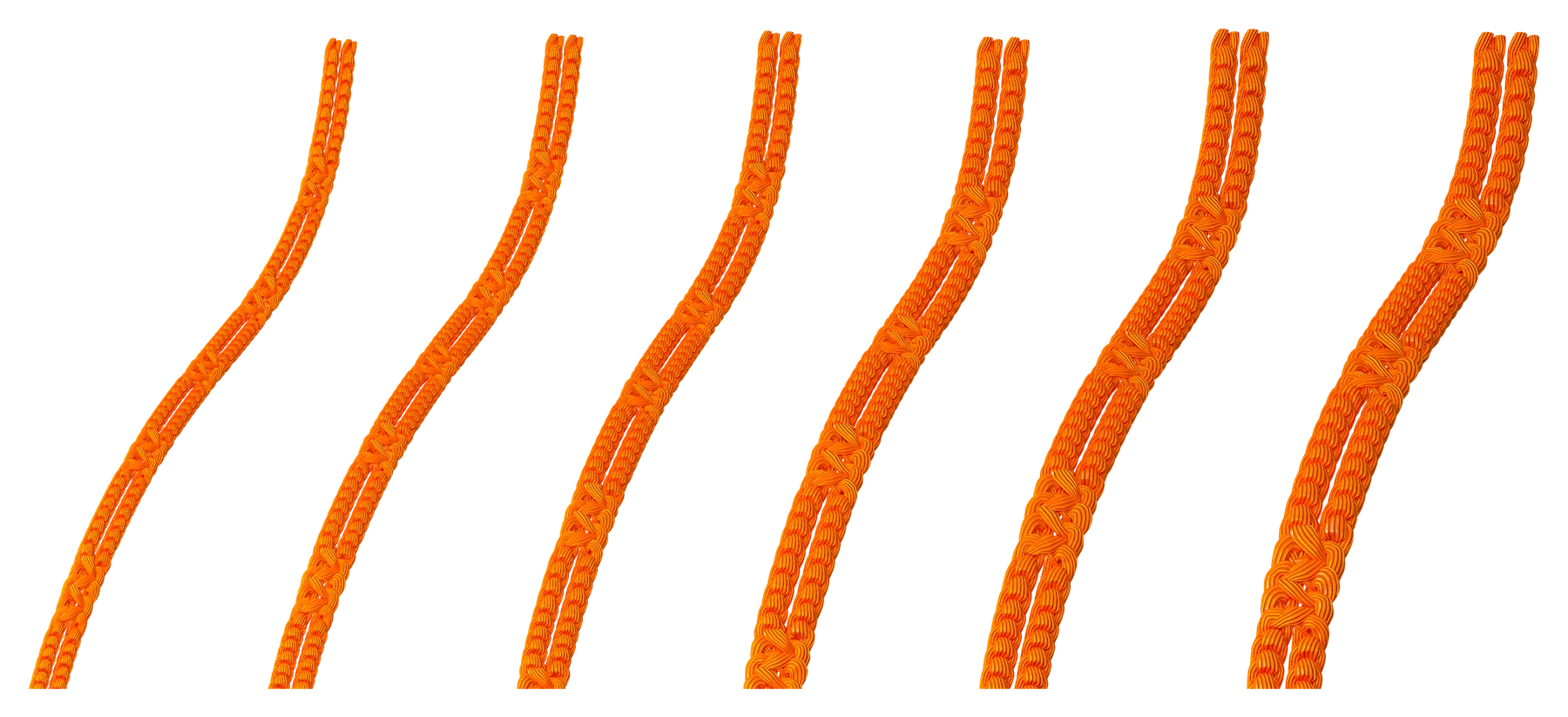
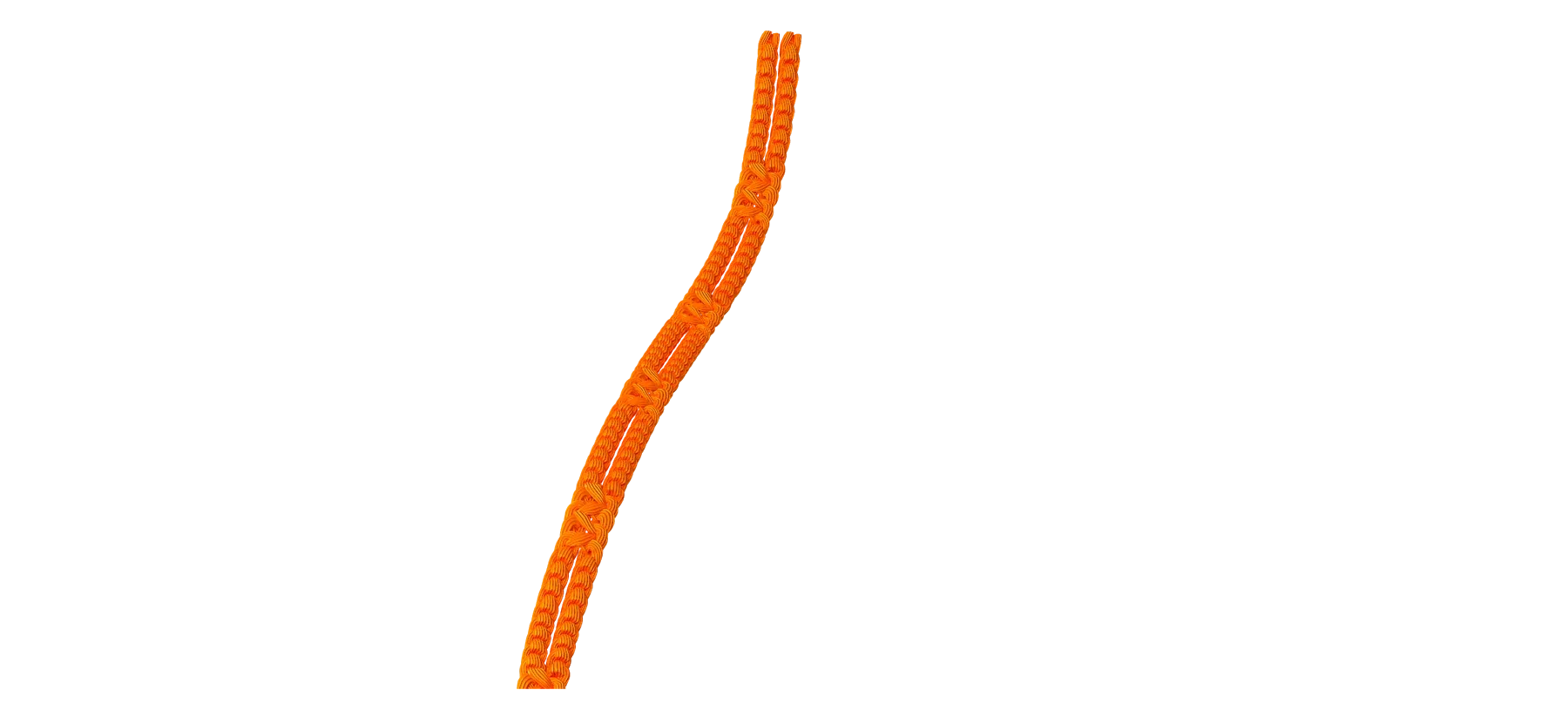
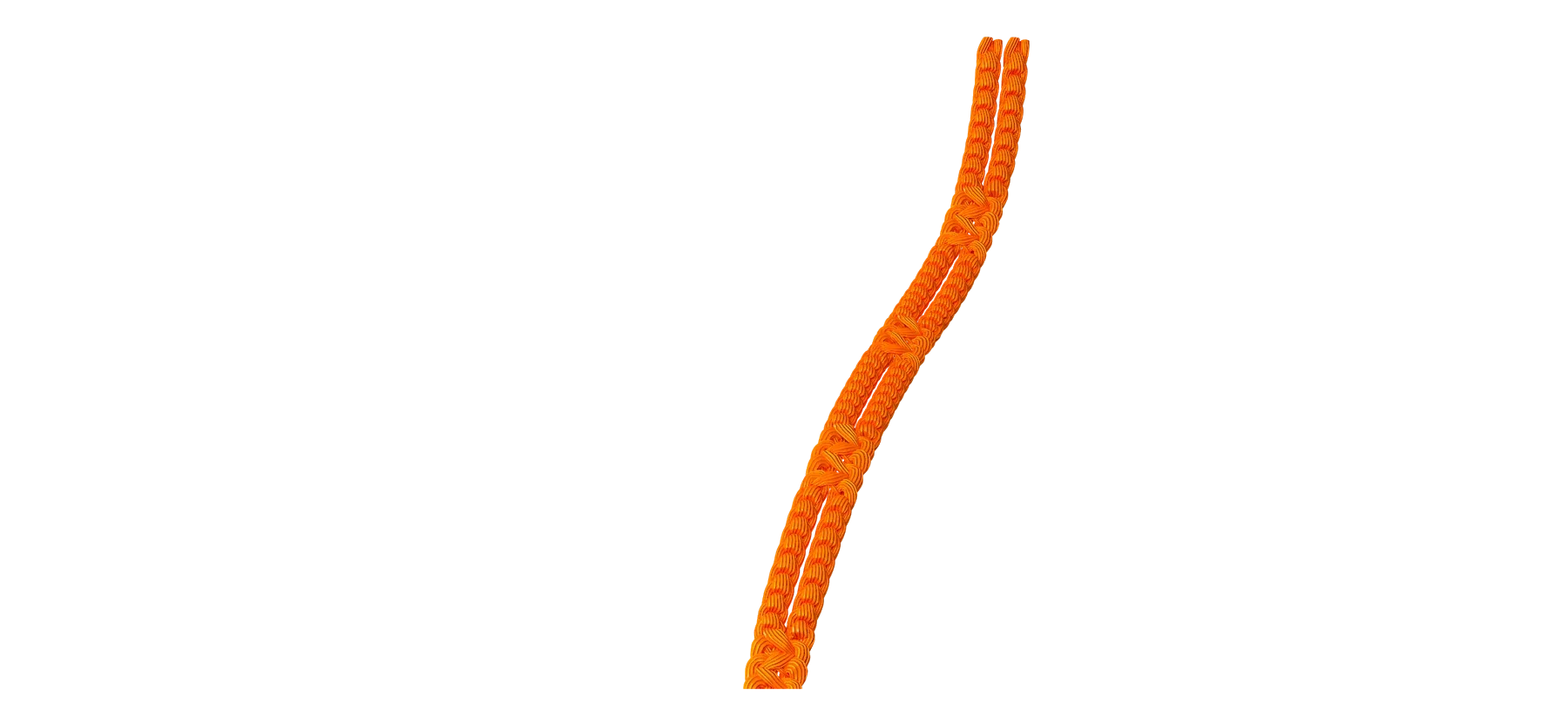
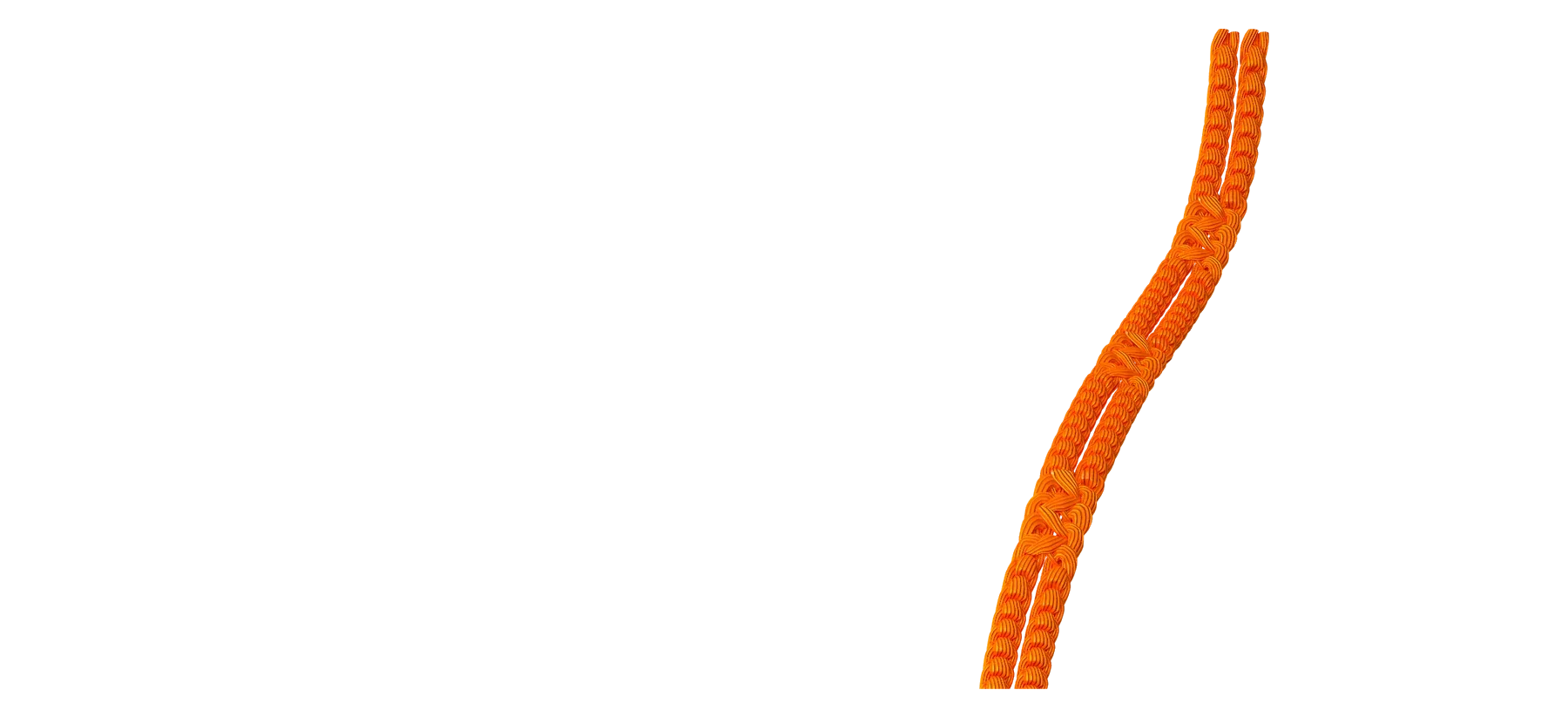
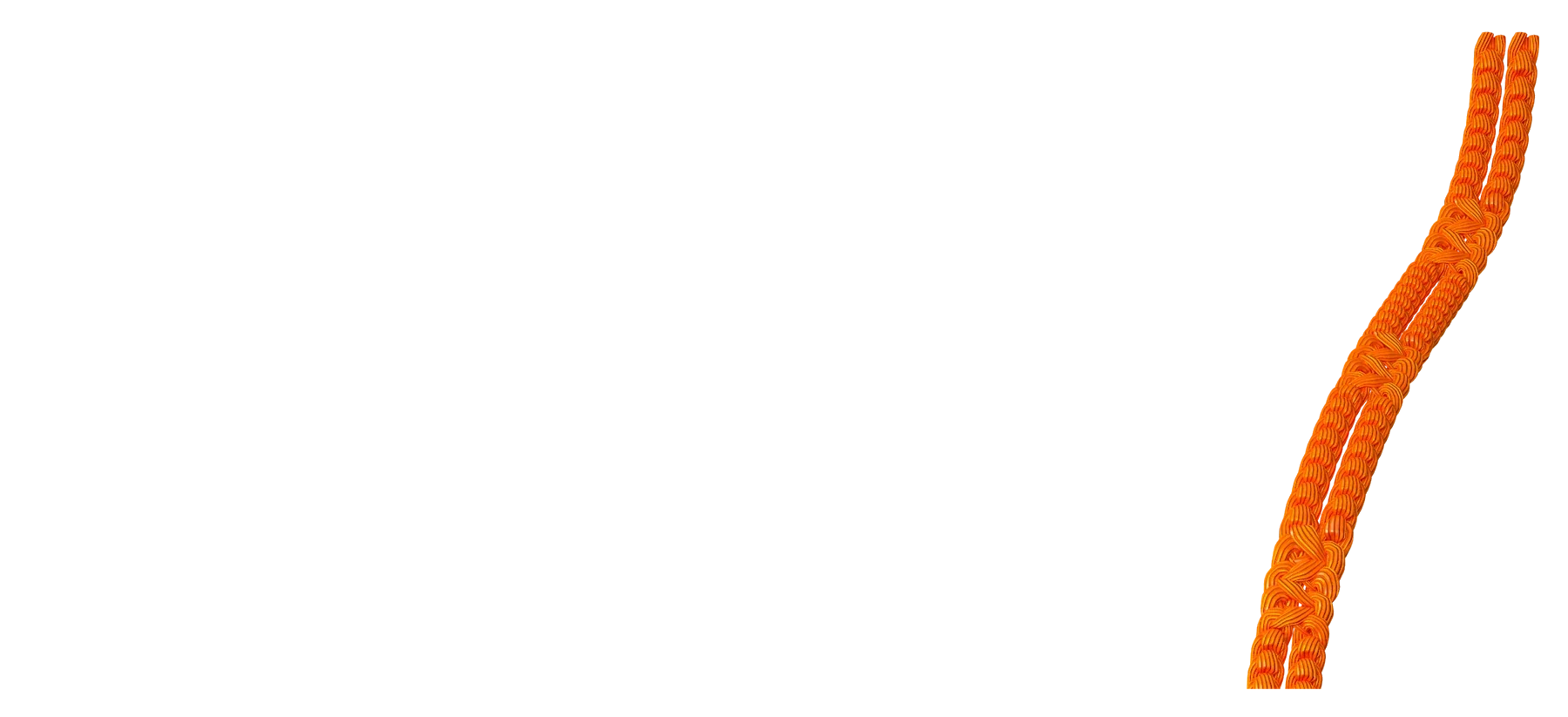
RunLock is a braided polyester rope whose two halves are braided together at regular intervals and run free in between. Every free stretch is a loop. That is the whole idea, and everything the rope can do follows from it.
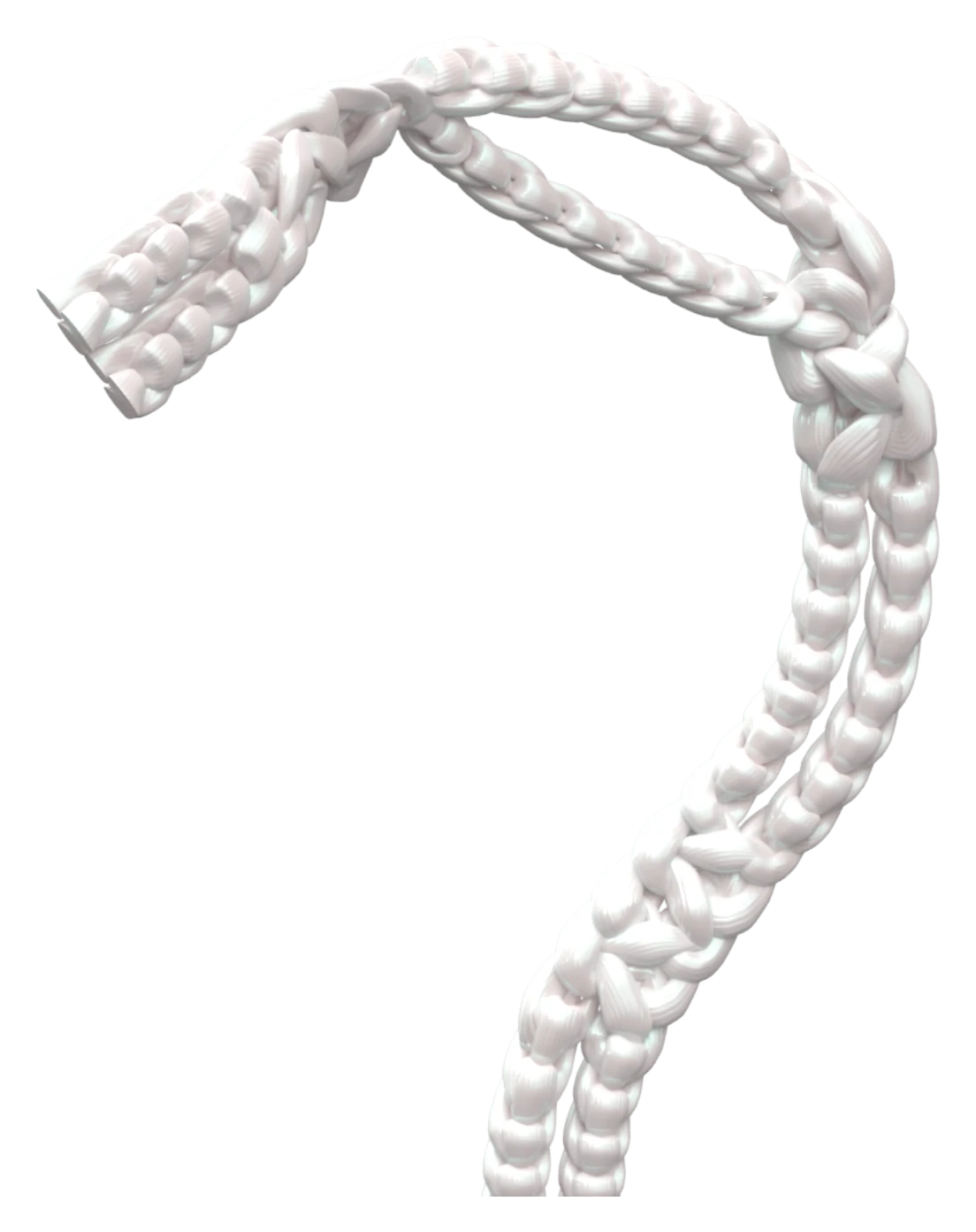
Two sides. Joined every few centimetres.
The rope is braided from polyester threads in two groups, one for each side. The size number is the number of threads in each group: a No 4 has 4 + 4 threads, a No 20 has 20 + 20. Every thread is three yarns twisted together. On the braiding machine the two groups are braided through each other for a short stretch, then run apart, then braided together again. Each time they meet, the groups swap sides. The free stretch is the loop. The braided stretch is the join that carries the load.
The size number is the thread count per side: No 4 is 4 + 4 threads, No 20 is 20 + 20. Each thread is three twisted yarns.
Shorter loops on the thin sizes, longer on the thick. The loop is where the rope goes through itself.
There is no knot to weaken the rope. The braided join carries the full breaking strength, from the first loop to the last.
No knot. Just the rope through itself.
Every RunLock lock is the same move: the rope, or a fold of it, is pushed through one of its own loops. When the rope is loaded, the loop is pulled tight around the part that passes through it. The harder you pull, the harder it grips. Slack it off and the grip opens again, because nothing has been tied.
That is why the rope does not lose strength at the lock. A knot bends a rope sharply around itself, and the fibres on the outside of the bend carry far more than the fibres on the inside. RunLock loads the braided join, which is made to carry the load straight through. The four locks differ only in how the rope is led through the loop: sliding (the running loop), fixed (the fixed loop), locked but quick to release (the quick loop) or wrapped around an anchor (the securing lock).
Because the loops sit every few centimetres, every lock is adjustable in steps of one loop. Move the end one loop forward and the rope is one loop shorter. There is nothing to retie.
Joining two ropes
Two RunLocks join loop to loop: pass the end of one through a loop of the other, then back through its own loop. The join holds like the rope itself and comes apart with one pull when the load is off. Join two No 16 to pull with more force, or a No 8 to a No 4 to reach a little further.
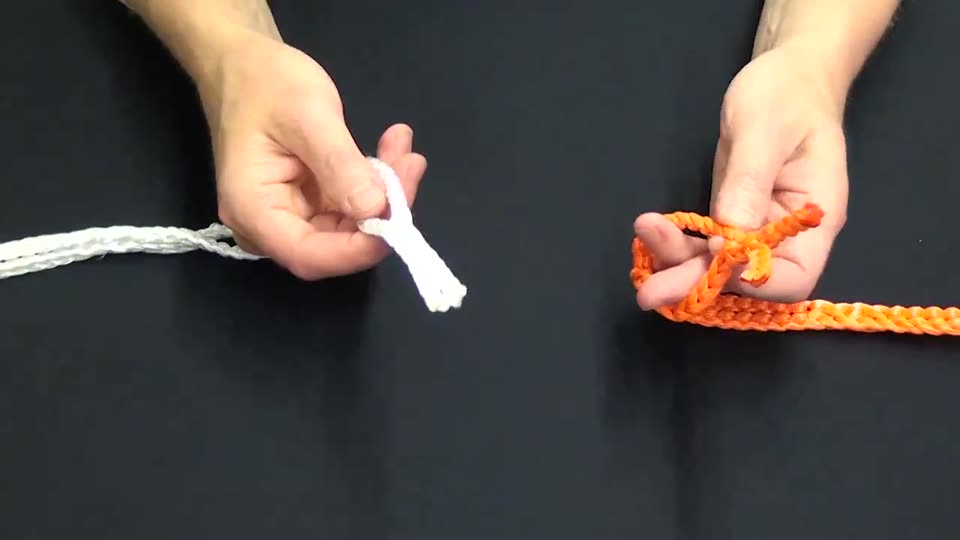 Two ropes joined
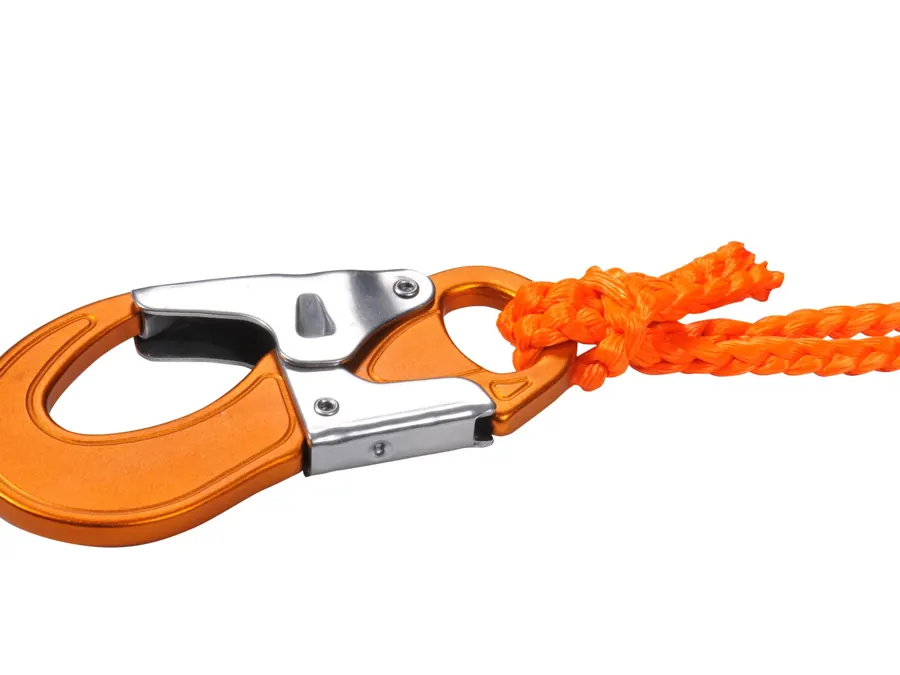 The four locks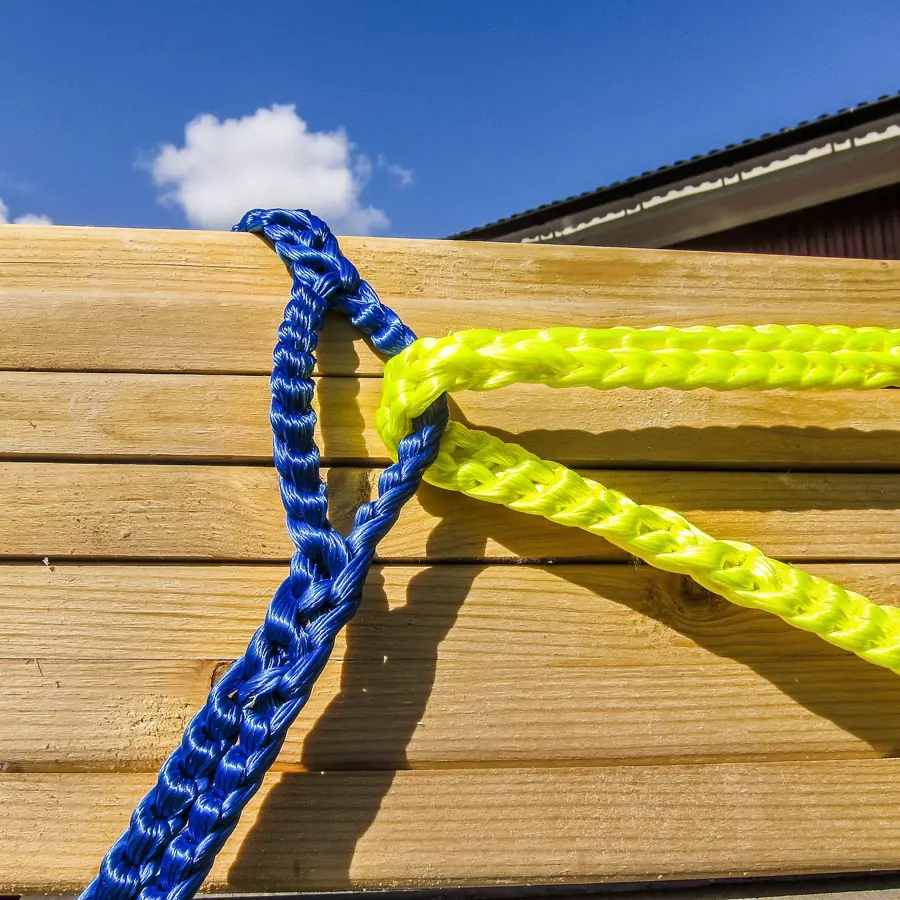
A yellow and a blue RunLock joined loop to loop. The join carries the full strength of the thinner rope.
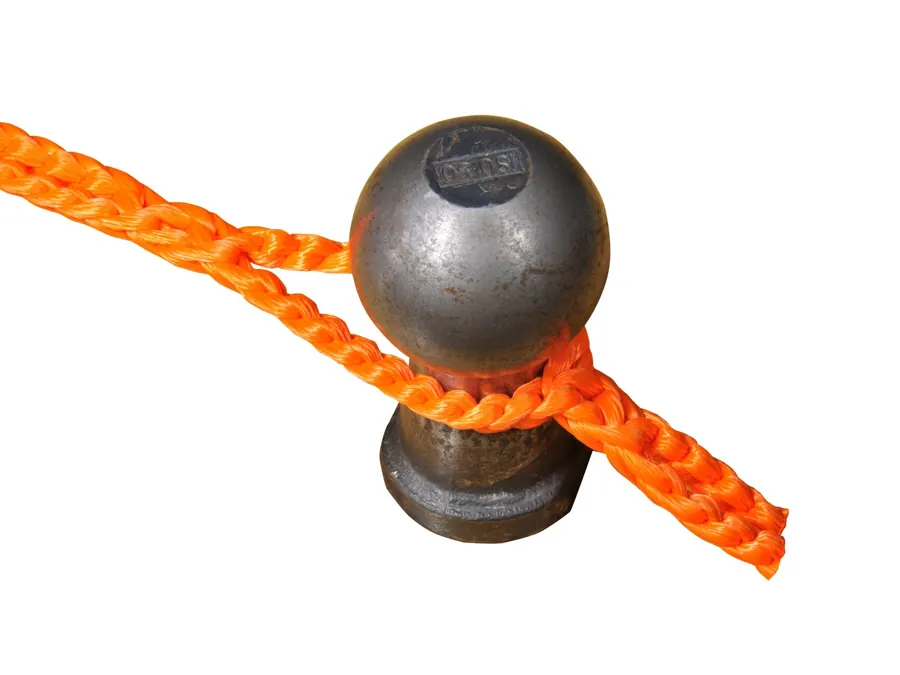
A running loop on a tow ball. The loop tightens under load and opens when the load is off.
Six sizes, one construction.
The number is the size. Diameter, loop length, strength and stretch all grow with it. Point at a rope, or tap it.
- Diameter
- 4 mm
- Loop length
- 40 mm
- Breaking strength
- 170 kg
- Tested at SP
- 209 kg
- Stretch at break
- 20.8 %
- Weight
- 13 g/m
The thin one. Washing lines, tent lines, hanging gear and clothes in the camp. 7 m weighs less than 100 g.
The rating is set with a margin below the breaking force measured at SP in 2016 (report 6P01208).
Bulk roll No 4 →Tested at SP, rated with a margin.
Every size has been pull-tested at SP, the Swedish national testing institute: a new rope, loaded in a straight pull until it breaks. The No 20 held 843 kg before it broke. We rate it at 700 kg, and every size gets its rating the same way, well below the force it actually held.
The rating is the strength of the rope, not the load to work it at every day. Tying down and pulling means jerks, wet rope and corners, so pick a size with strength to spare. For towing, that is the No 20 and a gentle start: the stretch in the rope smooths the pull out.
RunLock is a rope for pulling, tying down, hanging and leading. It is not a lifting sling or a climbing rope, and it is not certified for lifting loads over people.
Stretch
Every size stretches by a fifth to a quarter of its length before it breaks, 21 to 25 % in the SP test, and springs back when the load is off. In a towing line that stretch is what turns a jerk into a pull: the rope takes up the first metre of movement gently instead of passing the shock straight into the two cars. In a tie-down it is what keeps the load tight: the rope is slightly stretched when you lock it, and it keeps pulling as the load settles.
One metre of rope drawn to scale with its real loop length, on a centimetre ruler. Drag the handle to the right and let go. The rope gives easily at first and then stiffens, so the handle falls behind your hand the harder you pull, and the load climbs towards the breaking force measured at SP for that size without ever quite reaching it. Treat it as an illustration, not a measurement.
Polyester, because it behaves.
RunLock is 100 % polyester, chosen for how little it changes with weather, water and time.
Water
Polyester takes up almost no water. The rope does not swell, does not get heavy and does not stiffen when wet, and it keeps its strength wet or dry. It does not float.
Sun and cold
Good resistance to UV light, so the rope can live outdoors. The fibre keeps its flexibility in the cold, and a frozen RunLock still releases with one pull.
Oil, fuel and salt
Strong resistance to petroleum products, salt water and most everyday chemicals. Hang it in the garage, keep it in the boat.
Heat
Polyester melts at roughly 250 °C. That is what lets you seal a cut end with a lighter, and why the rope should be kept away from exhausts and open fire.
Wear
The braid is tight and smooth, so the rope runs through its own loops without fraying. Sharp edges are the enemy of any rope: pad them, or take the load on a fixed loop instead of a sliding one.
Soft on things
No hooks, no chains, no ratchets. The rope will not scratch paint, dent a canoe or rattle in the forest, and it is comfortable to pull by hand.
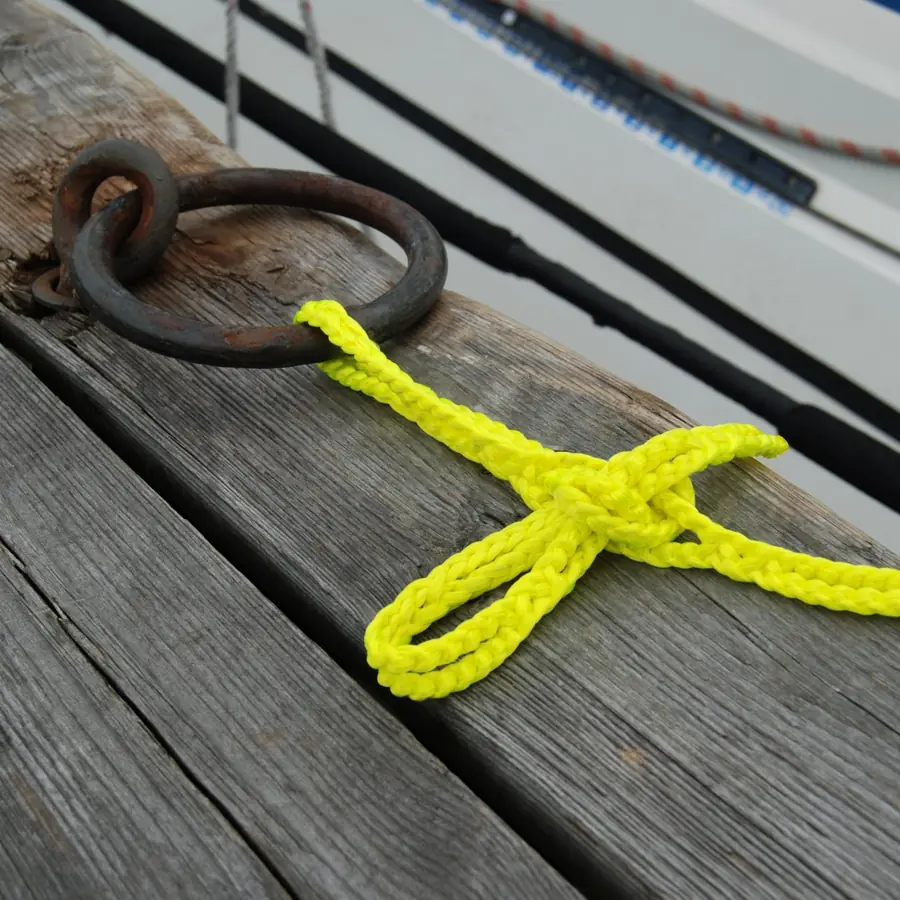
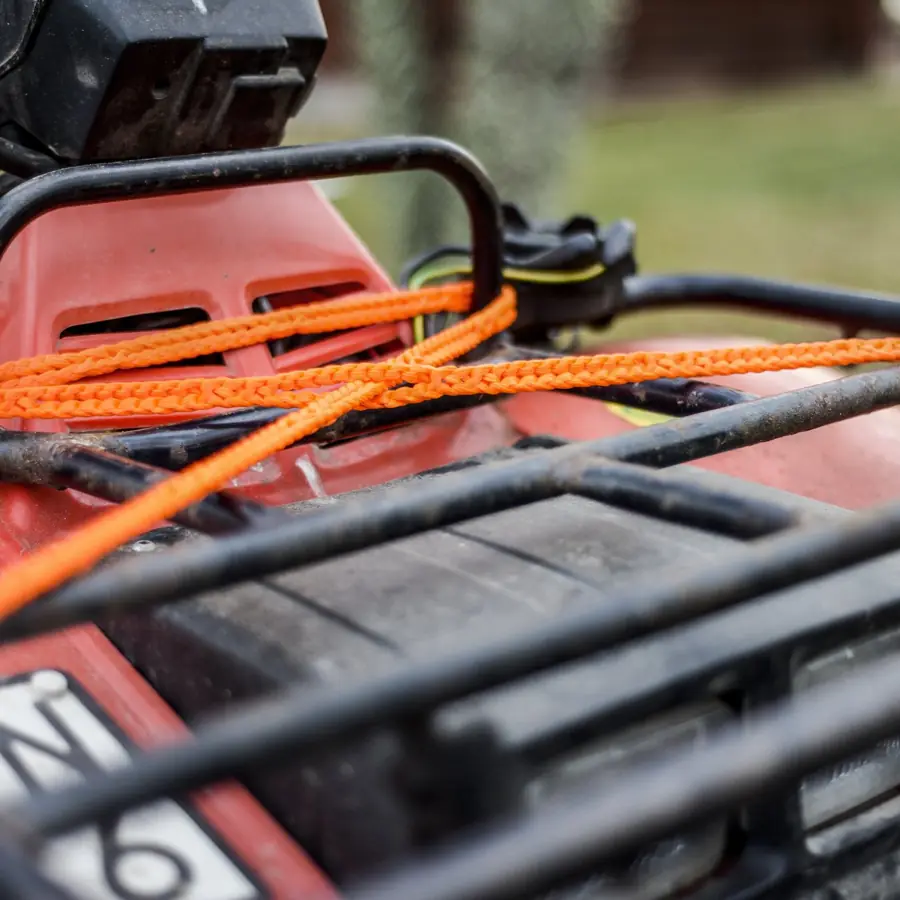
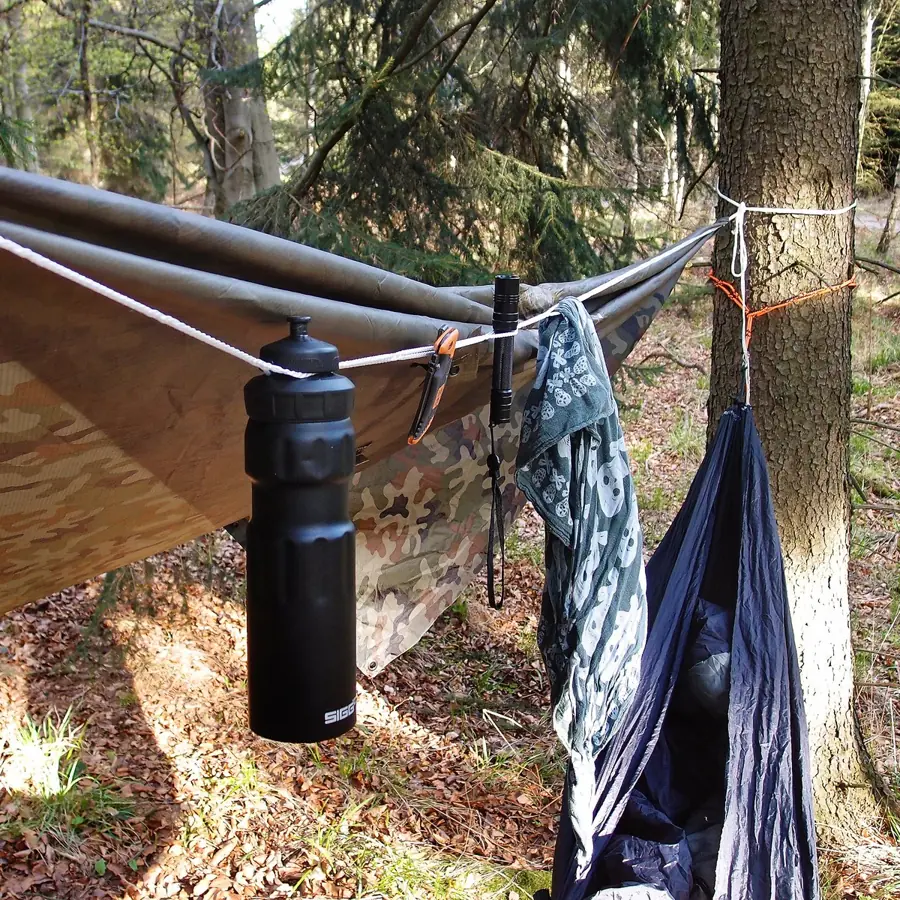
Cut it, wash it, keep it.
Cutting to length
Cut in the middle of a loop, across both strands. Then melt each cut end briefly with a lighter and press the two strands together, so the end is sealed in one piece and the last join holds. A cut length is a complete tool: no eye to splice, no hardware to fit.
Washing
Machine wash at 40 °C, without fabric softener. Let it dry hanging. Mud, salt and resin all come out, and the colours stay.
Inspection
Before a heavy pull, run the rope through your hands. Look for cut strands, a join that has come open, melted or glazed patches and loops that have stretched out of shape. A rope that has taken a real shock load or shows damage is retired to lighter work.
Storage
Coil it loosely and hang it dry. The rope tolerates sun, but a rope kept in the dark lasts longer than one left on the dashboard for years. Keep it away from sharp tools in the toolbox.
From the forests of Dalsland.
RunLock was born in 1983, when the founder of Texsolv needed a flexible, reliable rope for everything from pulling game out of the forest to hanging tools in the workshop. He took the loop idea from the Texsolv heddle cord that the factory had made for hand looms since 1977, and gave it a stronger braid and built-in stretch.
Since then Texsolv has braided every metre in Sweden, today at Vitlanda in Tösse. The breaking strengths were tested by SP, now RISE, the Swedish research institute, and RunLock has been supplied to armed forces, police and professionals as well as to hunters, boat owners, farmers and dog people around the world.
Tensile test at SP, Borås, January 2016
Six new ropes, 2 m long, one of each size, were pulled to breaking in a tensile testing machine at SP Structural and Solid Mechanics in Borås (now part of RISE). Each rope was fixed with 16.4 mm shackles, pre-loaded to 0.1 kN, and then loaded at a constant 50 mm/min until it broke. Every rope broke at the loop, not in the braid. Measurement uncertainty for the breaking force is below 1 %.
| Size | Breaking force | Elongation at break | Published rating |
|---|---|---|---|
| No 4 | 2.05 kN · 209 kg | 20.8 % | 170 kg |
| No 6 | 2.93 kN · 299 kg | 21.3 % | 230 kg |
| No 8 | 3.44 kN · 351 kg | 22.3 % | 290 kg |
| No 12 | 4.80 kN · 489 kg | 22.1 % | 480 kg |
| No 16 | 6.30 kN · 642 kg | 22.5 % | 580 kg |
| No 20 | 8.27 kN · 843 kg | 25.0 % | 700 kg |
The published ratings are set below the test results on purpose: one rope of each size was tested, and the rating leaves room for the spread between ropes. The elongation figures are the stretch at the moment of breaking, measured over the whole test length including the end loops.
Force against elongation, one curve per size. The end points are the measured breaking force and elongation from the report; the shape of the curves is redrawn after the report's diagrams, which show the rope stiffening as the load grows.
Get the rope
Pro packs, sets and bulk rope, shipped worldwide from Sweden. Larger orders: made to your spec →
Shop RunLock →